Range Repair
Viking burner ticks but will not light: what the delay is telling you
Clifford Nakamura Service technician — controls and intermittent faults · 22 years in the trade
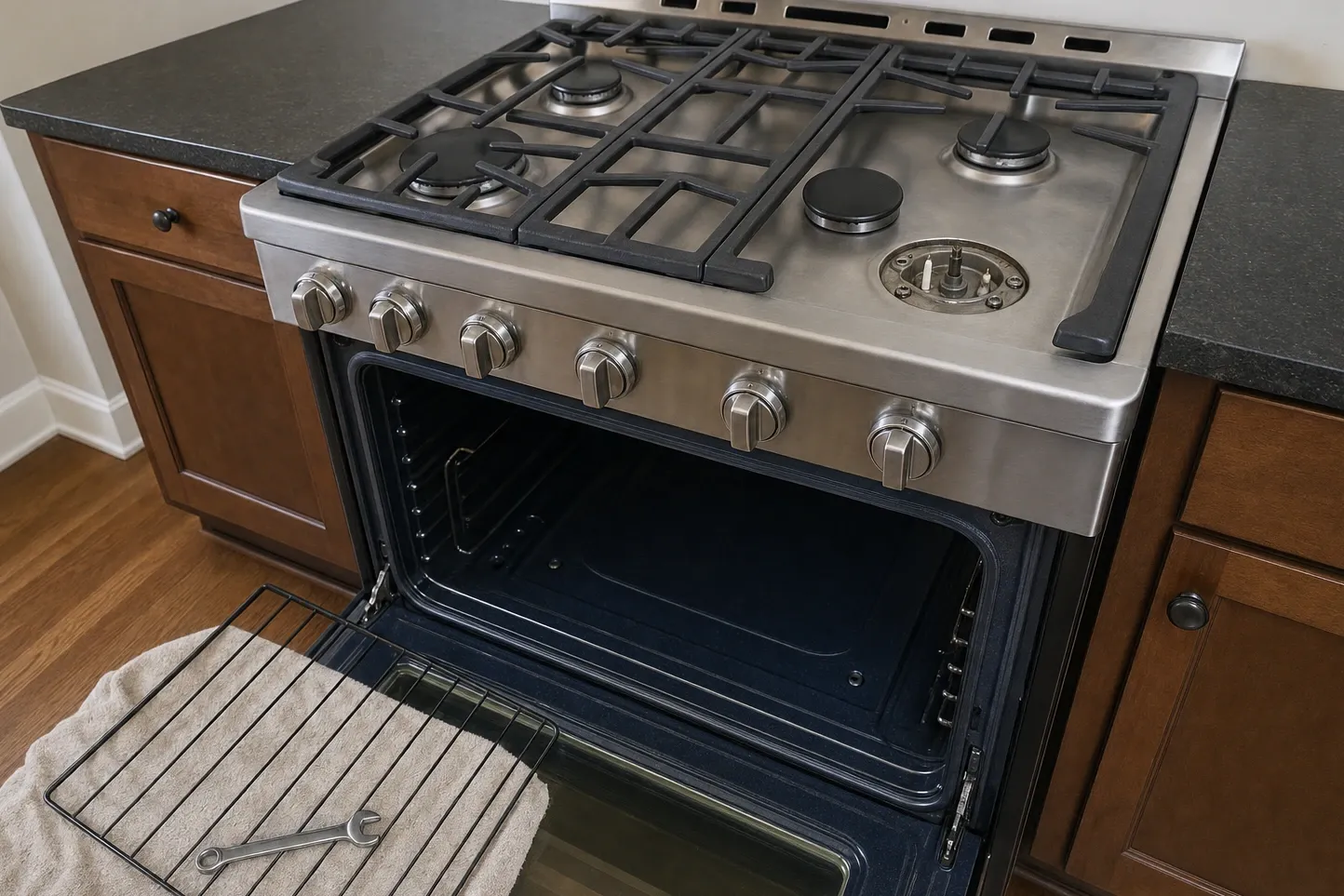
A burner that lit instantly on Monday and ticks for a minute on Friday has not developed a mysterious electrical fault. In nearly every case the spark is working perfectly and something has changed about the gas, the gap, or the moisture around the electrode. This is one of the cheapest faults on a professional rangetop to put right — and one of the most over-repaired, because the part that gets replaced first is usually the part that is still fine.
Here is what the pause means, what is worth checking yourself in five minutes, and where Denver’s thin air quietly makes the whole thing worse.
What the ticking actually is
Turn a knob to the light position and the control sends a train of sparks to the electrode sitting beside the burner head. The tick you hear is a spark crossing the small air gap between the steel tip of that electrode and the metal of the burner. Gas arrives through the orifice, mixes with air in the venturi, comes up through the ports, reaches the gap, and lights.
A delay means the sparking is happening but ignition is not, and there are only three ways that comes about.
The fuel is arriving slowly. Ports blocked with carbon or boil-over, a cap sitting proud, or an orifice partly obstructed. The mixture at the gap is too lean or too late.
The spark is landing in the wrong place. The white ceramic collar around the electrode is an insulator. Once it is cracked, sooted or glazed, the spark takes the easier path along that surface to the burner base instead of jumping the gap where the gas is. You still hear ticking. Nothing lights.
Water. After a heavy boil-over or an enthusiastic clean, a damp ceramic conducts just enough to bleed the spark away. This one usually fixes itself in a few hours and gets blamed on a part.
The four things worth checking before anyone comes out
- Look at the burners that do light. If their flames are tall, orange and lazy rather than tight and blue, the problem is the mixture across the whole rangetop, not one igniter. That points at orifices or manifold pressure.
- Take the grate and the cap off, cold. Find the electrode: a small steel pin in a white ceramic collar at the edge of the burner. Look for a hairline crack in the ceramic, or a brown glaze on it. Either one is a replacement.
- Dry it out. If there has been a spill, leave the burner apart for a couple of hours, or use a hairdryer on the cool setting. If ignition comes back, that was the whole fault and nothing needs buying.
- Clear the ports. A straightened paperclip or a stiff brush, working around the burner head. Never a drill bit or anything that widens a port — an enlarged port is a permanent flame problem in exchange for a temporary win.
One thing not to do: do not hold the knob at the light position through attempt after attempt. Each one releases gas that has nowhere to burn.
Why Denver makes a marginal igniter fail sooner
Air here is about a sixth thinner than at sea level. A gas appliance is designed around a ratio of air to gas, and at this elevation the same orifice hands the burner more gas than the available oxygen can burn cleanly. That is what makes the flame tall and orange instead of short and blue.
Rich flames do two things to ignition. They are harder to light at the gap in the first place, and they deposit soot — on the cap, on the burner head, and on the ceramic collar of the electrode. Soot on ceramic is conductive. So a rangetop still jetted for a coastal factory floor develops a slow ignition problem that gets worse the more you cook on it, and cleaning the electrode only buys time until the sooting puts it back.
The correct fix is the altitude orifice set, sized for elevation, plus a manifold pressure reading at the regulator to confirm the gas side is where the rating plate says it should be. Both are quick. Neither is guesswork, and neither is a new burner assembly.
When it is a part and not a clean
- Cracked ceramic, or a tip eroded round rather than pointed — the electrode is finished, and no amount of cleaning brings it back.
- One position never sparks while the rest tick happily — the electrode, its lead, or the switch under that knob.
- Every burner stopped ticking at once — now the spark module or the switch pack is genuinely suspect. This is the only symptom that makes the module the first thing to look at.
- Ticking that continues after the flame is up — a switch not releasing, or a cap seated wrong so the flame never reaches the sensing position.
- Gas you can smell — stop here. Knobs off, appliance valve closed if you can reach it safely, window open, and make the call from outside.
What it is not, most of the time
It is not the safety valve. It is rarely the spark module, for the reason above. It is almost never the regulator unless the flames are wrong on every burner at once, and in that case the flames are the symptom and the ignition delay is only a side effect.
If the electrode is intact and dry, the ports are clear, and the flames still burn tall and orange, the next step is a manometer on the manifold and an orifice check — a service call rather than a Saturday job. That visit and the diagnosis are what the $89 covers, and it comes off the repair once you approve it.
Follow-ups
Is it risky to keep trying a burner that ticks?
Repeatedly, yes. Every failed attempt puts unburnt gas around the burner head. Turn the knob off, give the room a minute, then try once more. If it does not catch on that attempt, leave it off and have it looked at rather than persisting.
Can I clean the igniter with wire wool?
Not the ceramic part. A brass brush or a stiff toothbrush on the steel tip is fine, but an abrasive on the white insulator leaves a conductive film behind, which is exactly the fault you were trying to clear. Dry cloth on the ceramic, nothing more.
Does a range bought in Denver already have altitude orifices fitted?
Sometimes. Sometimes the conversion kit is still taped inside the storage drawer, unopened. Tall orange flames on every burner and a simmer that will not hold usually answer the question before anyone takes a spanner to it.